

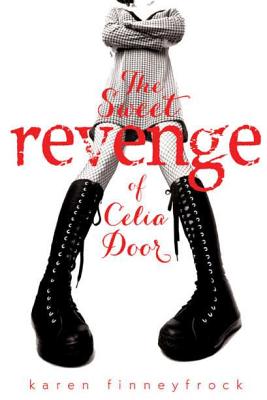
 by Karen Finneyfrock
ages: 13+
First sentence: “At fourteen I turned Dark.”
Support your local independent bookstore: buy it there!
Release date: February 21, 2013
Review copy provided by my place of employment.
Celia Door is determined to make a new start her freshman. She’s got her shell, her Darkness, and her poetry, and she is NOT going to let the things that happened in eighth grade, or her parents “trial” separation, get her down. Except this: she is going to, somehow, get back at the girls who ruined (!) her life with The Book in eighth grade.
I’m going to stop right here for a minute. One of the issues I had with this book was that we don’t find out what the big deal was about The Book in eighth grade, why these girls — Sandy and Mandy — were so mean, until nearly the end of the book. Granted, when we do find out, it’s a classic example of bullying, one that makes the two girls out to be real harpies. While I understood why it took so long for the author to reveal the reason behind Celia’s actions, knowing it sooner probably would have made Celia more sympathetic. Or, at the very least, made me less likely to want to smack her.
Back to the story.
Celia makes it through the first day, but things aren’t looking good. Sandy and Mandy are still on her case, she has no friends, and (horror of horrors) her Language Arts teacher isn’t sympathetic to Celia’s love of writing poetry. Things look Bleak until she meets Drake, a NYC transplant (he didn’t get into the art school he wanted, and his local PS is pathetic, so his parents sent him to live with his grandmother). He and Celia becomes friends: for him, she’s someone that’s edgy, unlike their suburban cookie-cutter classmates. For her, he’s someone who doesn’t know about The Book and has an air of Sophistication and Mystery that comes with being from NYC. And being gay.
On top of all that, things with Celia’s parents have gone from bad to worse, and she’s only feeling trapped in her life. (Another aside: I wanted to smack her mom, as well. Or, at the very least, shake her and tell her to talk TO her daughter instead of AT her. Parenting is so easy when it’s a book character, and you’re outside the book.)
For the most part, I liked this book, even with all its issue-button pushing. In fact, I may have liked it for that. While it’s not as powerful as some others I’ve read, it’s a solid book about bullying, about coming out and finding yourself, and about accepting things for what they are. It’s aimed for a younger readership than some of the other issue books I’ve read (aside from four “f-bombs” — which really didn’t feel out of place, to be totally honest — it’s pretty tame), and yet it still deals with things that kids have to deal with.
And for that, I applaud Finneyfrock.
 The Book Nut