

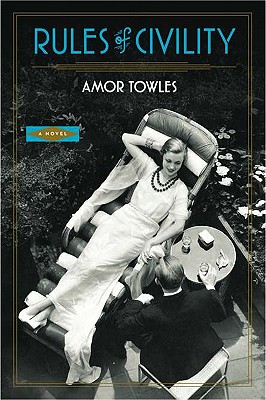
by Amor Towles
ages: adult
First sentence: “On the night of October 4th, 1966, Val and I, both in late middle age, attended the opening of Many Are Called at the Museum of Modern Art — the first exhibit of the portraits taken by Walker Evans in the late 1930s on the New York City subways with a hidden camera.”
Support your local independent bookstore: buy it there!
The thing that first drew me to this book (aside from the catchy cover), was that someone at work called it “Gatsby-esque.” Adoring all things Gatsby, I figured that I would (eventually) need/want to read this one. So, when it came through at the library, I snatched it, hoping to be thoroughly engrossed by it.
And I was. Sort of.
The setting is New York City, 1938. Our main character, Kate Kontent (the emphasis is on the second syllable), is a working girl from Brighton, trying to make ends meet. She rooms at a boarding house and there makes friends with Eve Ross, who has slightly higher ambitions. They’re out for a night on the town, when they meet — almost by accident — Tinker Grey: young, handsome, rich, suave. They both pounce, grasping at the chance to get out of the dead-end they’re in.
The book follows Kate’s year: one in which, either directly or indirectly because of Tinker, she gets a new (and better) job, dates a couple of rich socialites (while all the while pining, deep down, for Tinker), and watches as Eve managed to nab Tinker and swing into his lifestyle with ease. It’s a remarkable year, if only for the changes, and revelations it brings in Kate’s life.
It’s Gatsby-esque for the time period (roughly) and the love of jazz (again, roughly), but it’s missing all the other things — regret and fate as well as Gatsby’s elusiveness — that makes The Great Gatsby great. But, even though the characters are rich and reckless, with their lives and their money, there lacks a certain gravitas about it that would help give it a center. Perhaps it’s because Kate is really the least interesting person in the book: Tinker, Eve, and eventually her friends Wallace and Bitsy are all far more elegant and interesting. Once in a while Kate shows some class — like her love of books, and their organization system — but it wasn’t enough for me to truly care about the ups and downs of her year. And the end, the final twist and reveal, fell flat as well. Perhaps it was because by that point, I was really quite past caring.
I make it sound worse than it was; there was enough to keep me going, since I actually did finish the book. But, it’s not enough to make me love it.
 The Book Nut
I actually wish the secondary characters were in the book a bit more… They just kind of vanish.
LikeLike
I completely agree with everything you've said here. I too thought that Katey was the least interesting of all the characters, and when Eve and Tinker dropped out of the story I lost interest. Too bad because this book could have been great.
LikeLike